


By Agatha Nayame
The Shift from Manual Production to Intelligent Manufacturing
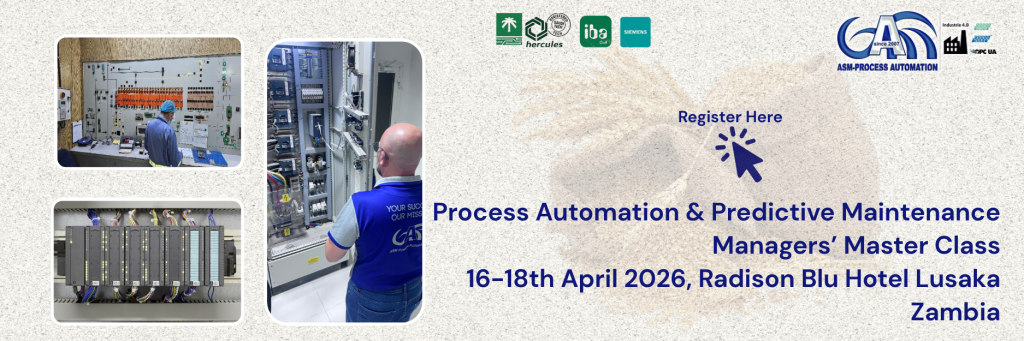
Across Africa’s emerging economies, industrial competitiveness is increasingly being defined by how effectively manufacturing systems are automated, for sectors such as grain milling, feed milling, and food & beverage production, automation infrastructure is no longer simply a technical upgrade it is a strategic investment that determines quality consistency, operational safety and long-term profitability.
In traditional processing environments, production quality is largely dependent on manual oversight. Operators must continuously monitor temperatures, moisture levels, mixing ratios and mechanical performance. While skilled personnel remain indispensable, manual systems often introduce variability, inefficiencies and a higher risk of operational error.
Automation changes this dynamic entirely.
Through the integration of sensors, programmable logic controllers (PLCs), advanced process control systems, and AI-enabled analytics, manufacturers are able to create intelligent plants that continuously monitor and regulate production parameters in real time. The result is a manufacturing ecosystem where precision, repeatability, and operational stability become standard rather than aspirational.
Quality Consistency: The Foundation of Competitive Food Systems
In milling and feed production, consistency is everything. Variations in moisture content, particle size, or ingredient ratios can compromise both product performance and consumer trust.
Automation systems ensure that each stage of production from grain intake to final packaging is controlled through data-driven process parameters. Automated dosing systems regulate ingredient quantities with precision, while real-time monitoring tools ensure that mixing, grinding, and conditioning processes operate within optimal specifications.
For flour mills, this means uniform product texture, reliable baking performance, and compliance with fortification standards. For feed mills, automation guarantees balanced nutritional formulations and improved feed conversion ratios for livestock.
The result is not merely operational efficiency it is brand reliability and market credibility
Food Safety and Process Integrity
Food safety remains one of the most critical challenges facing emerging food systems. Contamination risks, inconsistent hygiene practices and poor traceability mechanisms can undermine consumer confidence and restrict access to export markets.
Automation infrastructure significantly strengthens safety protocols within processing facilities.
Modern automated plants monitor critical control points such as temperature, humidity, microbial risk factors and processing times. These parameters are tracked continuously, enabling operators to intervene immediately if deviations occur.
Furthermore, automated systems create comprehensive digital traceability records. Every stage of production raw material intake, processing conditions, batch records, and packaging can be documented and analyzed.
For regulators and international buyers, this level of transparency demonstrates compliance with global food safety standards, strengthening Africa’s position in international food markets.
Predictive Intelligence: From Maintenance to Manufacturing Strategy
One of the most transformative developments in industrial automation is the emergence of predictive maintenance systems powered by artificial intelligence.
Traditional maintenance models rely on scheduled servicing or reactive repairs once equipment has already failed. Both approaches carry significant financial risks, including unplanned downtime, production losses, and expensive emergency repairs.
AI-enabled predictive maintenance systems analyze real-time equipment data collected through sensors and industrial monitoring platforms. These systems detect early warning signals vibration anomalies, temperature fluctuations, or energy consumption irregularities that indicate potential equipment degradation.
By identifying these patterns early, maintenance teams can intervene before a failure occurs.
For process industries, the benefits are substantial:
• Reduced downtime
• Lower maintenance costs
• Extended equipment lifespan
• Improved production reliability
In sectors where continuous operation is essential such as feed milling or beverage production predictive maintenance becomes a critical financial safeguard.
Data-Driven Manufacturing and AI-Powered KPIs
Automation infrastructure also enables a new level of operational intelligence through Industrial Internet of Things (IIoT) connectivity and Manufacturing Execution Systems (MES).
These systems collect real-time data across production lines and convert it into actionable insights through advanced analytics platforms. Plant managers gain immediate visibility into critical performance indicators, including:
• Overall Equipment Effectiveness (OEE)
• Production throughput rates
• Energy consumption efficiency
• Quality yield performance
• Downtime analysis
Artificial intelligence tools analyze these metrics continuously, allowing management teams to optimize production flows, identify inefficiencies, and forecast performance trends.
Instead of relying on historical reports or manual audits, decision-makers now operate with live production intelligence, enabling faster and more strategic responses to operational challenges.
Financial Predictability and Industrial Growth
Beyond technical advantages, automation infrastructure provides something every manufacturing executive values: predictable financial performance.
When production processes are automated and digitally monitored, manufacturers gain unprecedented control over cost drivers such as energy consumption, raw material usage, labor allocation, and machine efficiency.
Automation systems help reduce:
• Production waste
• Quality rejection rates
• Energy inefficiencies
• Unplanned operational disruptions
The result is a production environment where output becomes measurable, scalable, and financially predictable.
For investors and industry stakeholders, this predictability transforms manufacturing plants from operational risks into bankable industrial assets capable of sustaining long-term growth.
Automation and Africa’s Industrial Future

Africa’s population is projected to exceed two billion people within the next three decades. With this growth comes rising demand for safe, affordable, and consistently processed food products.
Meeting this demand will require a transformation in how production systems are designed and operated. Automation infrastructure offers a pathway toward efficient, resilient, and globally competitive manufacturing ecosystems.
By investing in automation technologies, African process industries can:
• Strengthen food security through efficient production
• Improve product safety and regulatory compliance
• Expand access to export markets
• Build data-driven manufacturing cultures
• Increase industrial productivity across emerging economies
Automation does not replace human expertise it enhances it. Engineers, operators, and technicians become the architects of intelligent manufacturing systems, capable of driving innovation across the continent’s food value chains.
A Strategic Imperative for Industry Leaders
“For executives in the milling, feed, and food & beverage sectors, the message is clear: automation infrastructure is no longer optional.
It is the foundation upon which the next generation of Africa’s industrial competitiveness will be built.
Organizations that invest early in intelligent production systems will benefit from greater operational resilience, stronger product integrity, and sustainable financial performance.
In Africa’s rapidly evolving manufacturing landscape, automation is not simply technology.
It is strategy, stability, and the engine of industrial transformation.
Copyrights Reserved: Zambian Miller 2026